Saturday, October 22, 2011

A Sponge or For Food?

Way back in the month May (like 150 days ago), I planted a seed for a "luffa" plant, and it sprouted. Little did I expect how it would grow.


From a single vine, this plant now in the month of October looks like this in the photo below. Notice the two "fruits" hanging from the fence.


The fruits of the luffa plant are edible, and is called "Chinese Okra". In Japan, it is called "Hechima". But in addition to being eaten, it has an "industrial" use as a sponge or scrubber, and is also called the "Sponge Gourd".

I was actually considering making a sponge from our homegrown luffa, and found some instructions online. As our gourds mature, I hope to let you know how it grows and goes.

Labels:

Saturday, June 04, 2011

Blackberry Flower

Earlier this spring, we planted a blackberry plant. So far, the "experiment" is growing well. The photo below is of the delicate white blackberry flower.


...And the flowers, of course, turn to blackberries!


Hikaru ate the first one, and he said it was so good!

Labels: ,

Thursday, May 19, 2011

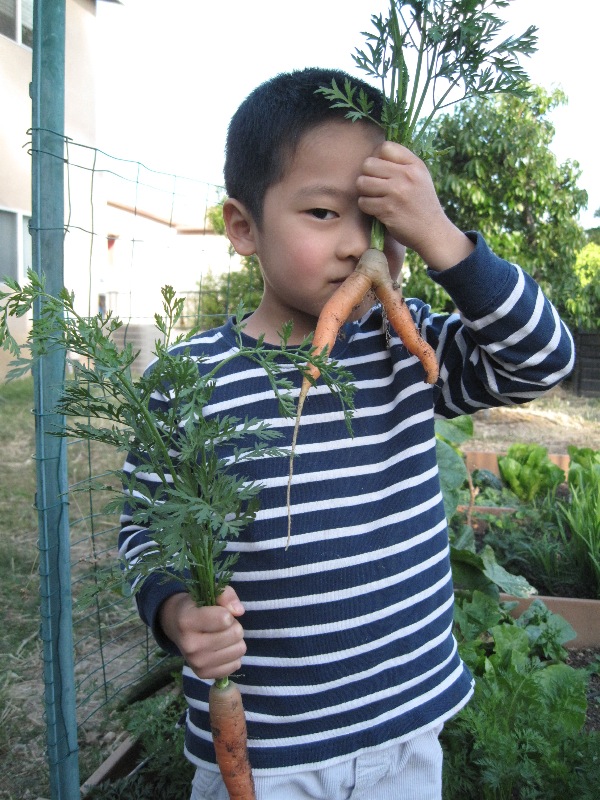
Carrot Moustache

Does this photo need any other words to go along with it?


This is another photo where Hikaru is showing off our cucumbers.

Labels: ,

Sunday, May 15, 2011

Carnivorous Plants and More

This weekend we went to the annual plant sale at the Huntington Gardens, and brought home a couple exotic new family members.


Hikaru wanted a carnivorous plant, so we got one. It's a Sundew. The nice thing about this plant is that we don't need to fertilize it; we only need to water it (with distilled water only). It feeds itself by the insects it catches.


Daddy got a herb called Stevia Rebaudiana (originally from Paraguay). It can be used as a sweetener.


However, stevia has had some controversy because it was banned in some countries. Why? It's been used in South America for centuries, but one might guess there is some special interest involved with non-sugar sweeteners. Stevia was only recently approved by the FDA in 2008. As far as we know, it's safe.

Labels:

Backyard Food Update for May

It's mid-May now. After a slight break during the wintertime, our backyard solar food generator seems to be at work again. The sunshine has been making the plants grow. The lettuce is ready, so we've been eating lots of salad. Also, we've harvested some of our spinach.


The pea pods are this year's hit -- especially with Hikaru who enjoys eating them. He says that the peas are his "favorite".


The cumbers are "almost" ready, and we watch them transform from yellow flowers to cucumber that we can eat.


They are blowing up like a little green balloon. The change in size over the course of a day is quite noticeable.


And finally, here's an inside view of our carrot forest. This may be their last picture before they are eaten.

Labels:

Plants Alive!

It sounds as if I'm really bored. But watching plants grow can be quite fun. Yes, really. For me, there's something fascinating about seeing the tendrils of a cumber or pea plant reaching out to grab and wrap around a wire or string.


Plants are very much living and moving creatures. This cucumber plant looks like Spiderman shooting out a web.


It's also not very hard to imagine tales like "Jack and the Beanstalk" when you see bean plans winding and climbing up a stick. In a couple days, it climbed about a 12 inches.

Labels:

Local Green Gardening

Yesterday, we had our first meeting of a local group of neighborhood residents interested in "green" gardening. We met each other through a sign-up sheet coordinated by Jesse Chang during the Monterey Park Earth Day Festival.

We talked about our possible goals. Besides an organic gardening and seeds/plants exchange group, there were more ambitious visions of developing a local community food bank of fresh fruits and vegetables. Imagine all the food that could be generated from people's backyard gardens! Dream.


Then we exchanged some plants. I took some tangerine tree seedlings, and brought home a green grape tomato seedling and some compost. Wow! Maybe only true organic gardeners could get excited about compost material and seeing rabbit poop.

I'm looking forward to future meetings.

Labels: ,

Sunday, April 24, 2011

2011 Backyard Garden Review

A couple years ago, in 2009, in the midst of the world economic crash, we started our raised garden bed. We learned a thing or two in the process, and we are very grateful. One source of personal satisfaction is to operate in the active mode of a producer rather the ordinary consumer of food. A large farm could be nice, but a small urban backyard (like ours) could work for a family too.


Our annual agricultural operating budget (in $) might look like this...

Water = $3 per month (or $36 per year)
Potting and Garden Soil = $20
Seeds and Seedlings = $20
Misc. Supplies and Fertilizers = $20

Our annual costs are roughly around $100. The previous year, we also invested some effort into an automated drip-irrigation system that cost around $200 with an electronic timer, anti-siphon valve, fittings, tubing, and some PVC pipe. It took me some labor and time to get set up, but it enabled us to take a vacation during a summer heat wave.

In return, we've received a lot of good organic food, including some agricultural education, physical exercise, and mental opportunities for peace and meditation. As a child development and education tool, our garden results in Hikaru (now 5 years old) willing to eat many fruits and vegetables, and understanding where our food comes from. So how do we really place a value on this, including our health? Of course, we can't place an economic value on the priceless.


Anyway, the 2011 growing season is finally here, and we're getting ready again. Here's a few updates for this year. As always, we plan to have our cherry tomatoes. I fashioned a modified tomato cage out of some tree branches, so we hope this works out. Last year, our over-productive tomato vines went crazily of control. I've also planted some basil and marigolds as companion plants for the tomato.


Like the previous year, while the weather is cooler, we've planted some leafy greens -- in this case, bok choy and romaine lettuce.


The lettuce and bok choy are grown from seeds. Sometimes they get eaten prematurely by unknown entities (birds, insects, slugs, whatever), but this year we've been quite lucky so far. I try to pick out slugs that I see by hand.


One new garden addition is Japanese cucumber. I've used some green vinyl-coated steel fencing to act as a trellis. In the past, we've grown larger cucumbers, but these are smaller (similar to Persian cucumbers). We'll see how these grow, and we love cucumbers in our salad.


I've also used some long tree branches to create a pyramid trellis for our peas and beans. I zig-zagged some string between the branches. As an experiment, we'll see how this setup works out too. Our peas are currently reaching for the sky. Never realized that they would grow so tall!


For our herbs and perennials, most of them remain healthy and well. The spearmint plant seems to enjoy its place inside the pot. I snip off some leaves for my daily mint tea, and it keeps growing back. Last year, the lower leaves yellowed and dropped off, but maybe it was getting too much sun or not enough water (mint seems to like lots of water).


However, our garlic chives had to be moved to a different location. The garlic chives grew extremely well, but it had a case of black-colored aphids. Few insects seem to touch the chives, but these aphids seem to exclusively like the chives. I may need to play "hide and seek" with the insects.

Our small peach tree is growing well. I performed some major pruning on this tree, and cut back some branches by about a third. My reasoning was that overly long branches could break, and won't be able to support as much weight (fruit) compared to the shorter ones. We may not have many peaches this year, but hopefully better for the overall future.


Finally, have you ever just planted some seeds in the soil, and see how well they'll grow? We received some tangerines and a pomelo during Chinese New Year. We we stuck some of the seeds inside some potting soil, and they've finally appeared as seedlings (after two months)!


Anyway, it's so cliche', but it often takes time for the seeds of a new generation to be realized into a tree. Patience is one important lesson we've learned from our garden -- especially, for a modern lifestyle that moves so quickly.

Labels:

Sunday, April 10, 2011

Composting Isn't a Waste

Compost makes me think about life's basics. Compost is decomposed (waste) plant matter. It's in the dirt under our feet. We wouldn't be alive, of course, if the soil couldn't sustain us -- to grow the food we eat.

Common sense may say that if one takes stuff out of the soil (for growing food), then one should put something back in. If nutrients in the soil (food plants need) are depleted, then we will not have healthy plants. And that means the food we (humans) eat may not have all the nutrients we need either.

So going back to compost... it is what we put back into our soil. It's overly simplistic, but if the compost also consists mostly of plants we took out of the soil, then the compost should have mostly what the plants need to grow, right? At least that's how I make sense of it.

In our home, the vegetable and fruit scraps all go into our compost bin -- banana and apple peels, broccoli stems, including egg shells (calcium). The plants and leaves that I cleared from our yard and garden, also get chopped up, and go into the compost.


Stuff like coffee grounds and tea bags can go in to the compost as well. Did you know that Starbucks (the coffee company) has used coffee grounds that you can take away (for free)?


In our urban environment, we have a compost bin that looks like the one below. We purchased it from the Los Angeles County Department of Public Works. It's made of plastic, and about 2 feet x 2 feet in size, and has a sliding door at the bottom to remove the composted material. One could probably just make a compost pile, but a container helps to keep rodents and other creatures out.

For people living in apartments, one can also create compost with a "worm bin".


I was curious, so I stuck my hand inside the compost pile to dig around. Yes, there's biological decay going on. There's earthworms too, and the compost is actually quite "warm" inside. How warm is it (you might ask)?


Using a digital multimeter I found out the temperature. I inserted the probe in the center of the compost bin (about one foot inside) for a mass of compost that's about two cubic feet (2' x 2' x 2'). The measured temperature was 30.5 degrees C (87 degrees F). That's warm considering the outdoor temperature was only 57 degrees F at the time.


For me, this shows me that there activity with billions of microbes working away on the compost. There's more going on than we realize. Here's one link to the Science of Composting.

Eventually, this compost ends up back in our garden, and the plants seem to appreciate it by the way they grow.

Labels:

Thursday, March 17, 2011

Japanese Garden Tools

With the rain this past winter, the grass in our backyard is growing like crazy. Here's a photo below...


I was looking for a "tool" to help me clear this grass. Yes, in Southern California, there are fire regulations to clear hillsides -- even though, the green grass looks quite nice to me.

In Little Tokyo (downtown Los Angeles) at the Anzen Hardware store, I found a solution that I couldn't find at Home Depot. It's a Japanese garden tool called a "kama" (sickle). I tested it out, and it worked perfectly for me. Also great for harvesting vegetables.


I'm not a fan of noisy weed wackers; it's a grate on my nerves. I have one, but it's messy, and I can picture the grass getting tangled up in the machinery.

On the other hand, a quiet "hand-powered" tool like the kama is a beautiful optimized technology that's been around for hundreds of years. It's hard to improve it. In a meditative work sort of way, the experience of cutting grass with the kama could be "relaxing".

Anyway, now that I have "the tool", I need to get busy!

Labels:

Raindrops on Peach Blossoms

There could be a poem I could write about the beauty of the peach blossoms on our tree after a California winter rainstorm, but maybe a photo will do instead.


Sorry, I haven't been posting much on our blog lately, but as you know, sometimes life gets busy. However, I've been doing some backyard work lately, so hope to add some new items.

One new addition to our backyard is a blackberry plant. It's a thorn-less variety called "Navajo". It has a Native American name because blackberries are native to this land. It's supposed to be able to tolerate heat. Sort of an experiment, so we'll see how it likes growing in LA this year.


Blackberries for me bring back childhood memories (with scratched up arms), since they used to grow wild behind our home. For this plant, I paid $6 at the local nursery. Seemed like a little too much for what used to grow like a "weed" in my parents' backyard. Blackberries are loaded with Vitamin C and antioxidants, so I'm looking forward to seeing this bush grow up.

Labels: , ,

Sunday, September 26, 2010

A Kabocha Universe

We harvested our first "kabocha" (Japanese pumpkin) from our garden. I read somewhere that kabocha originated from Cambodia, then and brought to Japan by the Portuguese in the 1500's. But we were happy to know that it will grow quite well in southern California.


The kabocha plant started out as seeds. After eating one for dinner one day (in late May), we stuck a few seeds in the soil. I was curious if they would grow, and then they sprouted. The plants grew, and grew, and grew... a bit on the wild side.

The sprawling vines extended around 20 feet down our hillside. It created its own "universe", and its broad leaves offered shade to lizards and other small creatures.


After a couple weeks, male and female flowers appeared. The big yellow kabocha flowers were pollinated by bees, and some "fruits" begins to form. (I've been told the flowers are good to eat as well.)


In the photo below, a dark green kabocha squash begins to form. We counted five of them.

The only complication we experienced was that this year was "cool" summer in Los Angeles, and mildew developed on some of large leaves. I sprayed the leaves with a mixture of baking soda and water. This seem to help.


After two months of growth, the leaves surrounding each squash started to turn yellow and then brown, and it was ready to pick.


However, one "surprise" was that a second round of growth started up. New leaves, flowers, and several more squashes are developing at this moment, so we look forward to possibly another harvest later this Fall.


Nutrition-wise, kabocha is high in beta carotene, iron, vitamin C, and potassium.


Usually when we cook it, we just cut it up into smaller pieces and steam it. Kabocha has sort of a dry starchy texture like a potato. We ate our first organic homegrown kabocha -- and it was good!

While it's often a challenge to have kids eat vegetables, Hikaru enjoyed it as well (probably because it's a little sweet).

Labels: ,

Friday, June 18, 2010

Life is Peachy

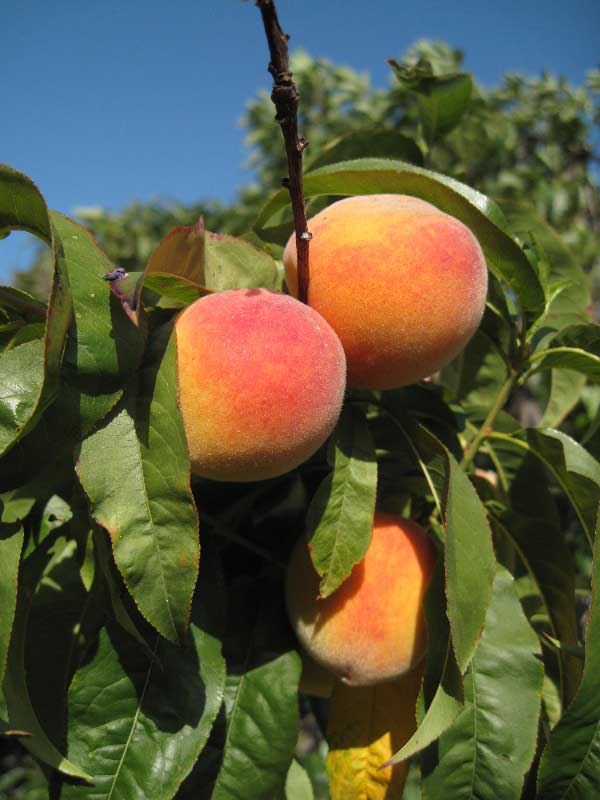
They were the "best" peaches we've ever tasted! This week, we tried the first peaches from our newly planted tree. Maybe it was due to the care that went into our peach tree or the Southern California sunshine, but they were so "good". Hikaru gobbled them up.


We counted 27 peaches on our very small tree. And Hikaru helped to pick them.

In the beginning, we wondered whether or not our peach tree would even grow, since our soil is mostly clay -- and peach trees like well-drained soil. But we planted it near the edge of a hill for the best drainage.

Also due to the rains this year, we had issues with something called peach leaf curl that's caused by a fungus. I picked most of the diseased leaves off by hand, and the issue went away.


While picking the peaches, Hikaru and I were very careful not step on Foo-Foo. Foo-Foo was our pet fish who passed away on the same day we planted our peach tree.

We placed Foo-Foo on a piece of cardboard with a brief farewell, and we buried him next to the tree. Hikaru knows the exact spot, and thinks Foo-Foo is living there. Yes, alive in spirit.

Labels:

Thursday, April 22, 2010

Carrots Are In!

One nice thing about living in Southern California is that we can plant carrots in February, and have them on our dinner table by April. We picked our first carrots from the garden, and we ate them about 5 minutes after taking this photo below.


In our mind anyway, these are the best and sweetest carrots we've ever eaten -- and 100 percent "organic" too! I can just feel that beta carotene and Vitamin A doing all sorts of healthy things inside our bodies. Boy, my vision just got better too!


Hikaru loves carrots. He wanted to show off these two "funny" carrots (above). Are these like two intertwined souls pulled from the earth?

Labels: